
In this guide, you will learn how to properly combine active ingredients such as retinoids, vitamin C, niacinamide, AHAs/BHAs and peptides, without irritation or unwanted skin reactions.
Why use active ingredients? Very simple - the skin regenerates intensively only when we stimulate it to do so. This is how all skin repairing and rejuvenation methods work, from microdermabrasion, lasers to injectable treatments. By cleverly combining active ingredients, the skin becomes more resilient, radiant and even.
Six basic rules for combining skincare ingredients
1. Don't combine too many active ingredients at once
Each skin has an individual tolerance threshold. If you use active ingredients, introduce them gradually. The active ingredients stimulate the skin and act in a targeted manner to produce a specific effect. Not all active substances are irritating, but some are, especially in higher concentrations, and the skin needs time to adapt.
2. Introduce strong ingredients slowly
The “low & slow” rule means:
start with lower concentrations
use them 2–3 times a week
then gradually increase the frequency
Thus, you reduce the risk of irritation, redness and damage to the skin barrier.
3. Don't mix everything at once
The general rule is: retinoids / ascorbic acid / AHA/BHA / azelaic acid = not together in the same routine.
4. Hydration balances active ingredients
For a routine with active ingredients, include:
moisturizing serum (hyaluron, glycerin)
cream that strengthens the barrier (ceramides, squalane, lipids)
They reduce irritation and strengthen the skin barrier.
5. Do layering according to the logic "from the lightest to the hardest"
The typical order is:
1️⃣ Cleansing
2️⃣ Toner / Essence
3️⃣ Watery serum
4️⃣ Oil serum / emulsion
5️⃣ Moisturizer / SPF (daytime only)
Sensitive skin - less steps is more.
6. Listen to your skin
If you feel burning, tightening, redness and flaking → take a break, simplify your routine and get back to basics. Re-introduce the active ingredient when the skin is ready.
Good and safe combinations (recommended)
+ Cica + ceramides
+ Niacinamide + retinoids
+ Azelaic acid + Cica
+ Panthenol + AHA/BHA acids
+ Hyaluronic acid + any active ingredient
+ Vitamin C und SPF
+ Peptides + moisturizing ingredients (e.g. ceramides, hyaluronic acid)
+ Retinoids + ceramides or rich moisturizing creams
When your skin is taking a break - recommended products
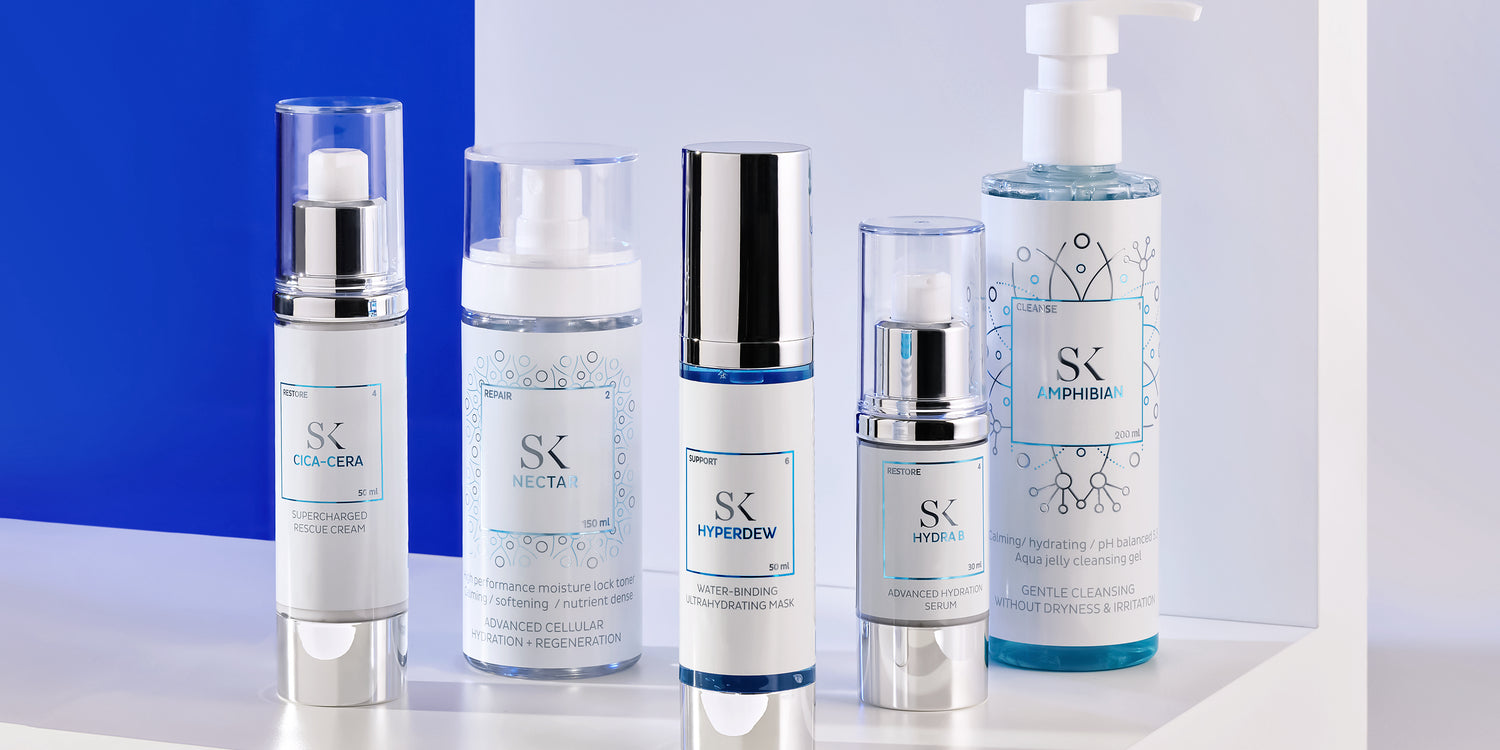
While your skin rests from active ingredients, neutral products provide optimal care and hydration. These products can also be used for the "sandwich method" on days when you use active ingredients.
Why are these products ideal "buffers"?
Maybe you're taking a break from active ingredients, or you're looking for a product that you can apply under / over the active ingredient you're introducing.
-
During the "buffer" period, the skin recovers from the intensity of active ingredients such as retinoids, AHAs / BHAs or vitamin C. During this period, the stratum corneum (the top layer of the skin) may be compromised, resulting in increased transepidermal water loss (TEWL) and reduced skin barrier function.
-
Recommended products contain key ingredients that support regeneration:
Ceramides - lipid molecules that fill the intercellular spaces in the stratum corneum, strengthening the barrier and reducing TEWL.
Niacinamide - promotes hydration, evens out skin tone, and strengthens barrier function.
Panthenol - provitamin B5, which is converted into pantothenic acid, which is essential for the renewal and hydration of the skin.
Squalane - a biomimetic lipid that mimics natural sebum, provides semiocclusion so that moisture remains in the skin, and the stratum corneum is soft and supple - without comedogenicity.
-
These ingredients allow the skin to regenerate without additional stress, preparing it for the next cycle of active care.
Recommended buffer / sandwich method products


Combinations that are best avoided in the same routine
High concentrations of acids along with pure vitamin C - ascorbic acid.
Both ingredients have a low pH value and can be very irritating to the skin, especially if it is sensitive. Vitamin C derivatives like SAP in Superba C have a more neutral pH value and are better tolerated by the skin.
Strong exfoliants/retinoids/benzoyl peroxide in the same evening
This is too aggressive for most skin types and increases the risk of barrier damage, flaking and redness. All of these ingredients work to stimulate cell renewal.
Multiple powerful active ingredients in one routine without hydration and barrier support
We should always remember that the skin has its own tolerance threshold. Without supporting the barrier function through neutral hydration and UV protection, we are risking unnecessary irritation from active ingredients - even the best ones.